
Lesson Materials
Watch the lesson, review the slides, or read the summaries.
Watch The Recording
Tap to play the recordingView Slides
Summaries
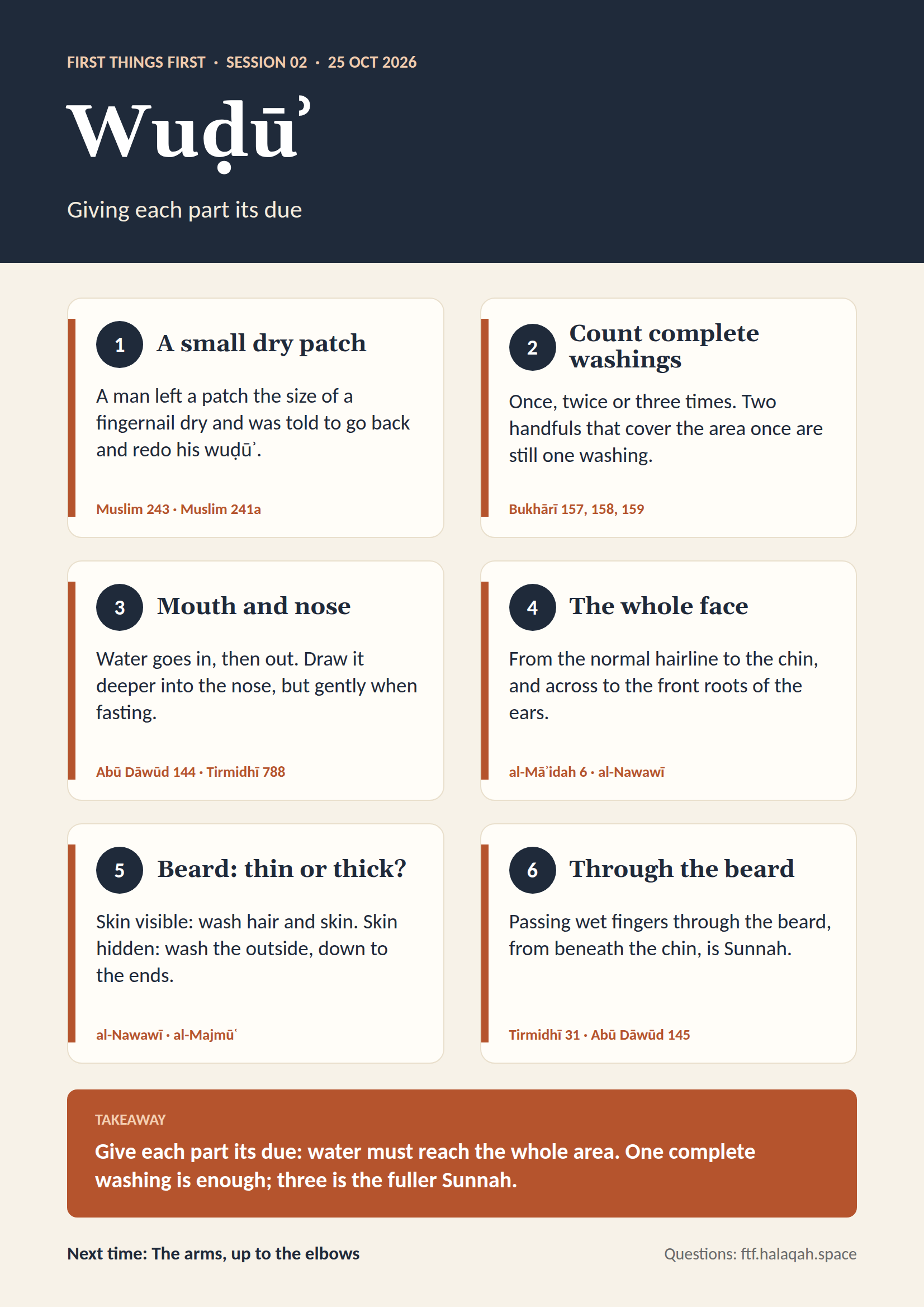
First Things First, Session 02, Sunday 25 Oct 2026. Written from the class recording and slides. Quran and hadith are referred to by source only: for the exact wording, see the slides or the source itself.
Why this lesson
- Last lesson gave the order of wuḍūʾ: hands, mouth and nose, face, arms, head, feet. This lesson looks at what completing each part involves.
- A man left a patch the size of a fingernail unwashed on his foot and was told to go back and perform his wuḍūʾ properly (Ṣaḥīḥ Muslim 243). As with the dry heels (Ṣaḥīḥ Muslim 241a), the problem was where the water did not reach, not how many times he washed.
- The command is to complete wuḍūʾ thoroughly (isbāgh). al-ʿAynī (ʿUmdat al-Qārī) explains it as giving each part its due.
How many times?
- Once for each part (Ṣaḥīḥ al-Bukhārī 157), twice (158) and three times (159) are all authentically reported. Once is the minimum and three times the fuller Sunnah. Washing a fourth time is not from the Sunnah.
- Count complete washings, not handfuls. If one handful leaves the elbow dry and a second handful reaches it, that is still one washing.
Hands, mouth and nose
- The opening hand washing, three times, is Sunnah in ordinary wuḍūʾ (Ṣaḥīḥ al-Bukhārī 159). The hands are washed again later with the arms.
- Mouth (maḍmaḍah): put water in, move it around and spit it out. Wetting only the lips is not enough (Sunan Abī Dāwūd 144).
- Nose: draw water in (istinshāq) and blow it out (istinthār) (Ṣaḥīḥ al-Bukhārī 161). Wetting only the outside of the nose is not enough.
- Laqīṭ ibn Ṣabirah was told: complete wuḍūʾ thoroughly, pass between the fingers, and rinse the nose thoroughly except when fasting (Jāmiʿ al-Tirmidhī 788). Draw the water further in, without pain; while fasting, rinse gently.
- One handful can serve both mouth and nose, three times (Ṣaḥīḥ al-Bukhārī 191). The majority, including the Shāfiʿī school, hold rinsing them is Sunnah; the position followed in this class is that it is obligatory.
The face
- "Wash your faces" (al-Māʾidah 6). The face runs from the normal hairline to the chin and lower ends of the jaw, and across to the front roots of the ears (al-Nawawī, al-Majmūʿ; Ibn Qudāmah, al-Mughnī).
- A receding hairline does not make the face bigger. Move hair that falls over the forehead, and do not miss the strip of skin between the beard and the ear.
The beard
- Thin: the skin can be seen through the hair at a normal conversational distance, so wash the hair and the skin. Thick: the skin is hidden, so washing the outside is enough. Thickness and length are different things.
- A long beard hanging below the chin is washed too: if thin, outside and inside; if thick, the outside down to the ends (al-Nawawī, al-Majmūʿ).
- Passing wet fingers through the beard (takhlīl) is Sunnah (Jāmiʿ al-Tirmidhī 31), taking a handful of water beneath the chin (Sunan Abī Dāwūd 145). It does not replace washing the outside.
In class
- If some parts of the beard are thick and some thin, treat each part by its kind. This is from the ease of the religion: Allah does not burden a soul beyond what it can bear (al-Baqarah 286).
- Mouth and nose may be rinsed separately, but the Sunnah is one handful for both.
Takeaway
Give each part its due: water must reach the whole area. One complete washing is enough, and three is the fuller Sunnah.
Next time: The arms, up to and including the elbows.
First Things First, Session 02, Sunday 25 Oct 2026. Written from the class recording and slides. Quran and hadith are referred to by source only: for the exact wording, see the slides or the source itself.
1. Where we are
In the previous lesson we followed the narrations of ʿUthmān and ʿAbdullāh ibn Zayd as they described the wuḍūʾ of the Prophet ﷺ, and we now have the main sequence: the hands, then the face, then the arms, then the head, then the feet. This lesson looks more closely at what happens as we go through it. This class covered the parts up to the beard; the rest of wuḍūʾ continues in the next lessons.
2. A small area remained dry
A man performed wuḍūʾ but left a patch on his foot the size of a fingernail unwashed. The Prophet ﷺ told him to go back and perform his wuḍūʾ properly (Ṣaḥīḥ Muslim 243, narrated by Jābir ibn ʿAbdullāh from ʿUmar ibn al-Khaṭṭāb).
Had he performed wuḍūʾ? Yes. So what was missing? An area that needed washing had stayed dry. The narration does not tell us how many times he washed; it draws our attention only to where the water had not reached.
We heard something similar in the previous lesson, when some people hurried their wuḍūʾ and their heels were visibly dry. The Prophet ﷺ warned, "Woe to the heels from the Fire", and in the same hadith said, "Complete your wuḍūʾ thoroughly" (Ṣaḥīḥ Muslim 241a, narrated by ʿAbdullāh ibn ʿAmr). That instruction is the main point of this lesson.
3. Isbāgh: giving each part its due
The Arabic word for completing wuḍūʾ thoroughly is isbāgh. al-ʿAynī, in his commentary on al-Bukhārī (ʿUmdat al-Qārī 2/258), explains it as giving each part its due.
That is what this lesson works through, one part at a time. When we wash an arm, where do we start and where do we end? If someone has a thick beard, must water reach the skin underneath? These details help us carry out the instruction to complete our wuḍūʾ thoroughly.
4. How many times?
Many of us learned to wash each part three times, and we do find that in the descriptions of the Prophet's ﷺ wuḍūʾ. But there are other descriptions too:
- Ibn ʿAbbās: once for each part (Ṣaḥīḥ al-Bukhārī 157).
- ʿAbdullāh ibn Zayd: twice for each part (Ṣaḥīḥ al-Bukhārī 158).
- ʿUthmān ibn ʿAffān: he washed his face three times, and his arms and feet three times (Ṣaḥīḥ al-Bukhārī 159).
All are reported authentically. So it is allowed to wash once, twice or three times: once is the minimum and three the most.
5. What counts as one washing?
Say we take a handful of water and wash the hand and forearm, but the elbow is still dry. We take another handful just for the elbow. Is that one washing or two? It is one washing, even though we used two handfuls.
Washing once means washing the whole prescribed area once, from beginning to end. Two, three or even four handfuls used to cover one part do not make four washings; it is still one complete washing, because until the elbow is wet the first washing is not finished.
- Point 1: we count complete washings of the part, not handfuls.
- Point 2: one complete washing fulfils the obligation, washing twice is also established, and three times is the fuller Sunnah. Repeating gives the water another chance to reach a spot we might have missed. Even if the first washing was complete, washing a second and third time is still recommended because it is the Prophet's ﷺ practice.
Can we wash four times to be extra sure? No. Three is the maximum, and going beyond the Sunnah is never better than it.
6. The hands at the beginning
In ʿUthmān's demonstration, he asked for water, poured it over his hands and washed them three times (Ṣaḥīḥ al-Bukhārī 159). This is the first action: washing the whole hand, the palms, the backs and the fingers.
This opening hand washing is Sunnah (mustaḥabb) in ordinary wuḍūʾ. After the face, we come back to the hands again as part of the obligatory washing of the arms. Keep those two places in mind.
7. The mouth
There is a direct instruction: when you perform wuḍūʾ, rinse your mouth (Sunan Abī Dāwūd 144, narrated by Laqīṭ ibn Ṣabirah). Maḍmaḍah is to put water in the mouth, move it around and spit it out.
If only the lips are wet and the inside of the mouth stays dry, the mouth has not been washed. At the same time there is no need to put a finger inside to reach every corner; what matters is that the inside of the mouth is washed with water.
8. The nose: in, then out
A narration in al-Bukhārī tells the one making wuḍūʾ to expel water from the nose (Ṣaḥīḥ al-Bukhārī 161, narrated by Abū Hurayrah). Blowing it out is istinthār; drawing water in is istinshāq, because to expel water we must first bring it in. Wetting the outside of the nose while leaving the inside dry is not washing the nose in wuḍūʾ.
9. Laqīṭ's question and the fuller rinsing
Laqīṭ ibn Ṣabirah asked about wuḍūʾ. The answer: complete wuḍūʾ thoroughly, pass between the fingers, and rinse the nose thoroughly, except when fasting (Jāmiʿ al-Tirmidhī 788). The same word for completing thoroughly appears again.
- Between the fingers: water is hard to reach there, so passing it between the fingers is part of completing wuḍūʾ thoroughly. This returns when we wash the arms.
- Rinsing the nose thoroughly: draw the water in with a breath so it goes deep, towards the furthest part inside. Bringing water into the nose fulfils the basic action; drawing it further in is the additional Sunnah.
- Except when fasting: deep rinsing risks water passing through to the stomach and breaking the fast. While fasting, draw the water in gently.
Do it as far as you can without pain. It may be uncomfortable the first few times; if it is only discomfort, train yourself gradually. There is no particular sensation we must produce, and water reaching the throat is a risk, not the aim.
10. One handful for mouth and nose
ʿAbdullāh ibn Zayd's description adds that the Prophet ﷺ used the same handful for the mouth and the nose, and repeated that three times (Ṣaḥīḥ al-Bukhārī 191). Take a fresh handful in the right hand, put some into the mouth and draw the rest into the nose, breathe in sharply, then rinse the mouth and blow out the nose. It takes practice, so it helps to practise outside wuḍūʾ.
The ruling. Some of us were taught that rinsing the mouth and nose is Sunnah, and that is the majority position, including the Shāfiʿī school. Other scholars regard both as obligatory, based on the commands in the narrations, and that is the position followed in this class. The disagreement is about whether leaving them invalidates wuḍūʾ; there is no doubt the Prophet ﷺ washed both in multiple narrations, so to follow the complete Sunnah we do it every time.
- Point 3: water enters the mouth and the nose and is then expelled. One proper rinsing fulfils the minimum, two is allowed and three is the fuller Sunnah. While fasting, draw water into the nose gently.
11. The face
Allah says, "Wash your faces" (Sūrah al-Māʾidah, āyah 6), and ʿUthmān washed his face three times. But for even one washing to be complete, where must the water reach?
- Top to bottom: from the normal hairline down to the chin and the lower ends of the jaw.
- Side to side: across to the front roots of the ears, the small piece of flesh at the front of the ear, which is part of the face.
(al-Nawawī, al-Majmūʿ; Ibn Qudāmah, al-Mughnī.) Picture the whole area: the forehead, nose, cheeks, around the mouth and chin, and the sides near the ears.
A single hand wiped once from top to bottom will very likely miss parts. If possible, use both hands, from the top of the forehead down to the chin and from side to side. It takes a little extra effort to make sure every part is washed.
- Why "normal" hairline? Hair may recede with age, but the face does not get bigger: the area that has lost its hair is still part of the head.
- Hair over the forehead: move it aside so water reaches the skin underneath. Where our hair lies does not change the boundaries of the face.
- Beside the beard: between the beard and the ear there is a small strip of exposed skin that is easy to miss. It is part of the face.
- Point 4: wash the whole face within these boundaries, using our hands to help the water reach every part.
12. The beard: thin or thick?
First we distinguish a thin beard from a thick one, and thickness is different from length. At a normal conversational distance, can someone see the skin through the hair? If so, the beard is thin. If they see only hair, it is thick. There is no need to inspect closely or part the hairs. A short beard can be thick, and a long beard can be thin.
"Long" here means hair extending below the face boundary, hanging below the chin. The required washing (al-Nawawī, al-Majmūʿ 1/408-409, 413-415):
- Short and thin: wash the hair fully, outside and inside, and the skin underneath. There is no hanging portion.
- Short and thick: wash the outside, without needing to reach the skin underneath.
- Long and thin: wash the hair and the skin over the face, and wash the hanging hair outside and inside, passing the fingers through it.
- Long and thick: wash the outside, both over the face and the hanging part, to the ends.
13. Passing the fingers through the beard
ʿUthmān reported that the Prophet ﷺ would pass his fingers through his beard (Jāmiʿ al-Tirmidhī 31). Anas described it: he took a handful of water, brought it beneath his chin and worked it through his beard (Sunan Abī Dāwūd 145).
This passing of wet fingers through the beard, takhlīl, is recommended (mustaḥabb, Sunnah). For a thick beard, washing the outside is the obligation (wājib). The main point is getting the water in; to follow the Sunnah, bring a handful beneath the chin and work it through the beard. Passing the fingers through it does not replace washing the outside.
- Point 5: look at the thickness to decide whether water must reach the skin. Thin: water must reach the skin. Thick: washing the outside is enough.
14. Five points so far
- Count complete washings, not handfuls.
- One washing is sufficient, and three is the fuller Sunnah.
- Water enters the mouth and the nose, drawn deep into the nose except when fasting.
- Wash the whole face, from the normal hairline to the chin and from ear to ear.
- The beard: wash according to its thickness and whether it hangs below the chin.
15. Class discussion
- Some parts thick, some thin? Deal with each part by its kind: where it is thin, make sure water reaches the skin; where it is thick, washing the outside is enough. This is from the ease of the religion: Allah does not burden a soul beyond what it can bear (Sūrah al-Baqarah, āyah 286). Reaching the skin under a very thick beard would be hard, while for a thin beard it takes a second.
- Can the mouth and nose be rinsed separately? Yes, but the Sunnah is the single handful described above.
- The warning about the heels and the Fire: does it mean only that part will be in the Fire, or the whole person? We believe what we were told, and how it happens Allah knows best. What we take from it is the severe warning for anyone who does not complete wuḍūʾ thoroughly, and that is the most important point of this lesson.
Questions can also be posted in the group or through the website during the week.
Takeaway
Give each part its due: water must reach the whole area you wash. Count complete washings, not handfuls; one is enough and three is the fuller Sunnah.
Next time: The arms, up to and including the elbows.
References used in this lesson
Ṣaḥīḥ Muslim 241a, 243; Ṣaḥīḥ al-Bukhārī 157, 158, 159, 161, 191; Sunan Abī Dāwūd 144, 145; Jāmiʿ al-Tirmidhī 31, 788; Sūrah al-Māʾidah 6; Sūrah al-Baqarah 286; al-ʿAynī, ʿUmdat al-Qārī 2/258; al-Nawawī, al-Majmūʿ 1/408-409, 413-415; Ibn Qudāmah, al-Mughnī.
Questions and Answers
Have a question about this lesson? Ask it during the week. Ustadz Fawwaz answers, and answered questions appear below.
Want to track your progress and keep your questions in one place? Join the Classroom.