
Lesson Materials
Watch the lesson, review the slides, or read the summaries.
Watch The Recording
Tap to play the recordingView Slides
Summaries
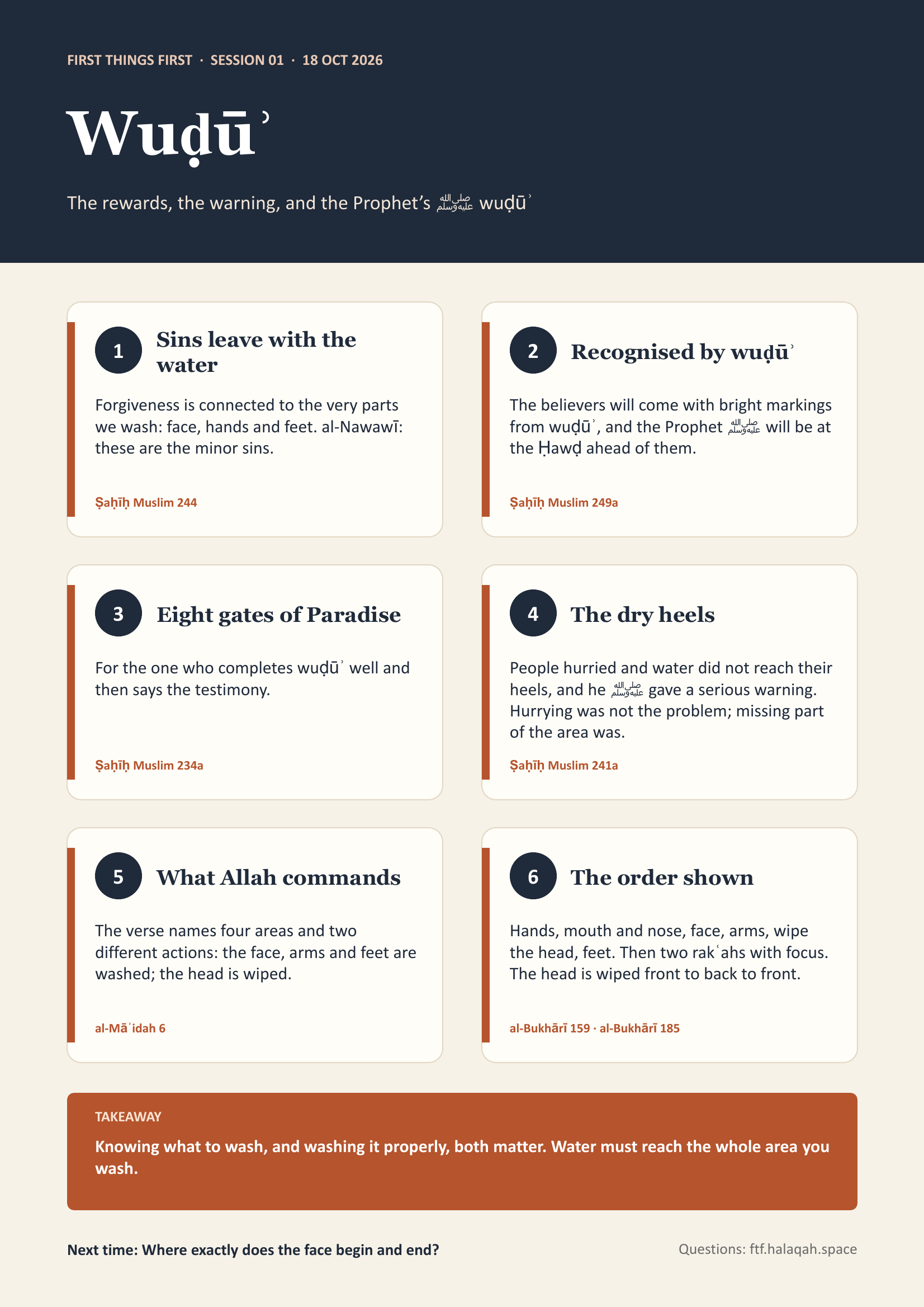
First Things First, Session 01, Sunday 18 Oct 2026. Written from the class recording and slides. Quran and hadith are referred to by source only: for the exact wording, see the slides or the source itself.
Why this lesson
- We have made wuḍūʾ thousands of times, often without thinking. This lesson asks: what are its rewards, what does Allah command, and how did the Prophet ﷺ do it?
The rewards
- Forgiveness: sins connected to the eyes, hands and feet leave with the water as each part is washed (Ṣaḥīḥ Muslim 244). al-Nawawī explains these are the minor sins; major sins need their own repentance.
- Recognition: the Prophet ﷺ will recognise his Ummah by the bright markings of wuḍūʾ at the Ḥawḍ (Ṣaḥīḥ Muslim 249a).
- Eight gates of Paradise: for the one who completes wuḍūʾ well and then says the testimony we studied in the Tawhid lesson (Ṣaḥīḥ Muslim 234a).
The warning
- Some people hurried their wuḍūʾ and water did not reach their heels; the Prophet ﷺ warned them seriously (Ṣaḥīḥ Muslim 241a).
- Hurrying was not the problem in itself. The problem was that part of the area to be washed stayed dry. This concerns something visible; it is not a reason to doubt every past wuḍūʾ.
What Allah commands
- The verse names four areas with two different actions (al-Māʾidah 6): the face, the arms (including the elbows) and the feet (including the ankles) are washed; the head is wiped.
- Washing means the water actually reaches the area. Wiping means passing wet hands over the head.
How the Prophet ﷺ did it
- ʿUthmān's demonstration (Ṣaḥīḥ al-Bukhārī 159): 1) wash both hands, 2) rinse mouth and nose, 3) wash face, 4) wash arms to the elbows, 5) wipe the head, 6) wash feet to the ankles.
- The hands at the start (to the wrists) are a different washing from the arms (to the elbows).
- The same report promises forgiveness for praying two rakʿahs after such a wuḍūʾ without becoming absorbed in other thoughts. A passing thought is different from being absorbed.
- ʿAbdullāh ibn Zayd (Ṣaḥīḥ al-Bukhārī 185) adds how the head was wiped: front to back, then back to the front. Some counts differ between the two reports; which actions are required comes in later lessons.
In class
- Students answered in the chat: the people with dry heels had washed their feet, but not every part of them.
- To wash the face properly we need to know its boundaries.
Takeaway
Knowing the order and knowing the area are both knowledge. Water must reach the whole area you wash.
Next time: Where exactly does the face begin and end?
First Things First, Session 01, Sunday 18 Oct 2026. Written from the class recording and slides. Quran and hadith are referred to by source only: for the exact wording, see the slides or the source itself.
1. Introduction
After the first lesson on the meaning of lā ilāha illallāh, the class turned to something we have done for years. Most of us have made wuḍūʾ thousands of times, often learned as children from our parents, and can now do it almost without thinking. That is a great blessing, but there are things about wuḍūʾ we can easily overlook: what its rewards are, which parts are obligatory and which are sunnah, and how many times each part is washed. The lesson began with the rewards, because they help us appreciate what we are learning before we get into the details.
2. Reward one: sins leave with the water
In a hadith in Ṣaḥīḥ Muslim (244, narrated by Abū Hurayrah), the Prophet ﷺ described forgiveness connected to the very parts we wash: when the face is washed, sins connected to what the eyes looked at leave with the water; when the hands are washed, sins the hands committed; and when the feet are washed, sins the feet walked towards, until the person comes out purified.
Our eyes may have looked at what they should not, our hands may have done things we regret, our feet may have taken us where we should not have gone. So we can finish wuḍūʾ thinking not only "now I am ready to pray" but also of this mercy: even on a day of many mistakes, Allah has given us repeated chances to return to Him.
al-Nawawī, in his explanation of Ṣaḥīḥ Muslim, explains that these are the minor sins; major sins need their own specific repentance. That is an important qualification, but the promise is still very great.
3. Reward two: recognised by wuḍūʾ
In another hadith in Ṣaḥīḥ Muslim (249a, narrated by Abū Hurayrah), the Prophet ﷺ, at a graveyard, expressed his wish to see "our brothers", meaning the believers who would come after his Companions. They asked how he would recognise those of his Ummah he had never met. He gave an example they understood: a man whose horses have clear white markings on their foreheads and legs, standing among completely dark horses, will recognise his own. His Ummah will come on the Day of Resurrection with bright markings from wuḍūʾ, and he ﷺ will be ahead of them at the Ḥawḍ, his water basin on that Day.
4. Reward three: the eight gates of Paradise
A third report in Ṣaḥīḥ Muslim (234a, narrated by ʿUqbah ibn ʿĀmir from ʿUmar ibn al-Khaṭṭāb) connects the opening of all eight gates of Paradise, entering by whichever one he wishes, to a person who completes wuḍūʾ well and then says the testimony. The narration preserves two Arabic wordings for "completes it", both meaning properly and thoroughly.
Notice that the testimony we studied in the first lesson appears here: we do not need a special occasion to say it; we can say it every time we prepare for ṣalāh. Three things come before the promise: making wuḍūʾ, doing it properly and thoroughly, and then saying the testimony. Which raises the question: what does it mean to complete wuḍūʾ properly?
5. The warning: a hurried wuḍūʾ
ʿAbdullāh ibn ʿAmr (not to be confused with ʿAbdullāh ibn Zayd, met later) described returning with the Prophet ﷺ from Makkah to Madinah. At some water along the road, some people hurried to make wuḍūʾ around ʿAṣr, and when the others reached them their heels were visibly dry. The Prophet ﷺ gave them a serious warning about the heels and the Fire, and told them to complete their wuḍūʾ thoroughly (Ṣaḥīḥ Muslim 241a).
The class was asked in the chat what went wrong. Answers included "didn't wash the feet properly" and "hurried wuḍūʾ". The point: hurrying is not the problem in itself, as long as water covers the whole foot. The report does not say they forgot to wash three times. The problem was that water had not reached part of the area they had to wash. Every part of the face, arms and feet must actually be washed.
So knowing what to wash is one matter, and knowing how to wash it properly is another. At the same time, this incident is about something visible: we should not start doubting every wuḍūʾ we have ever made. We take the warning as seriously as we take the promises.
6. What Allah commands
Sūrah al-Māʾidah, āyah 6, tells us what to do when we rise for prayer. It names four areas and what to do with each:
- Face: wash. Water must actually reach it; running a damp hand over it is not washing.
- Arms, including the elbows: wash. Stopping short could leave the elbow dry; the exact boundaries come in the next lesson.
- Head: wipe. A different verb: we pass wet hands over the head; we are not required to pour water over it.
- Feet, including the ankles: wash. The heels are part of the feet, which is why water failing to reach them was so serious.
So there are two separate questions: which part, and what do we do with it. A general principle was also given: the Quran often gives the general ruling and the Sunnah gives the details of how to carry it out, just as the Quran commands prayer while the number of rakʿahs in each prayer is known from the Sunnah.
7. How the Prophet ﷺ performed wuḍūʾ: ʿUthmān's demonstration
The best-known report is from ʿUthmān ibn ʿAffān, the third caliph, narrated by Ḥumrān, who served him (Ṣaḥīḥ al-Bukhārī 159). ʿUthmān asked for water and showed how the Prophet ﷺ made wuḍūʾ. The order:
- Hands at the start, washed three times. This is only up to the wrists, and is separate from the later washing of the arms.
- Mouth and nose: rinsing the mouth (maḍmaḍah) and drawing water into the nose (istinshāq). No count is given in this wording.
- Face, three times. The verse starts with the face, but in practice it comes third, after two actions the verse does not mention.
- Arms to and including the elbows, three times.
- Head: wiped, the same action Allah commands in al-Māʾidah. Wiped once, not three times.
- Feet to the ankles, washed three times.
In the chat, students put the six actions in order correctly, and identified the head as the one action that is wiped rather than washed, once.
Is three times required? The evidences must be combined before deciding. There are reports of the Prophet ﷺ washing parts three times, twice and once, which shows once is the minimum and three times the most complete. Varying it with the intention of following the Sunnah is also rewarded. Which actions are required, and how much is enough, will come in later lessons.
8. Two rakʿahs after wuḍūʾ
In the same report, ʿUthmān mentioned a promise from the Prophet ﷺ: previous sins forgiven for the one who makes wuḍūʾ like this and then prays two rakʿahs without becoming absorbed in other thoughts. Many of us stand for ṣalāh and find our minds going to work, family or something we forgot. The scholars explain that a passing thought we do not follow is different from letting ourselves become absorbed in unrelated thoughts. So we work on our focus (khushūʿ), ask Allah for help, and do not give up because a thought crossed our mind.
9. A second Companion: ʿAbdullāh ibn Zayd
Someone asked ʿAbdullāh ibn Zayd to show how the Messenger of Allah ﷺ made wuḍūʾ, and he did (Ṣaḥīḥ al-Bukhārī 185). His report adds a detail about the head: it was wiped with both hands, starting at the front, moving to the back, then returning to where he began (front, back, front). If a child asks how the Prophet ﷺ wiped his head, we can now answer from an actual report.
Comparing the two reports, ʿUthmān (Ṣaḥīḥ al-Bukhārī 159) and ʿAbdullāh ibn Zayd (Ṣaḥīḥ al-Bukhārī 185):
- Hands at the start: ʿUthmān three times; ʿAbdullāh ibn Zayd twice.
- Mouth and nose: ʿUthmān not stated in this wording; ʿAbdullāh ibn Zayd three times.
- Face: ʿUthmān three times; ʿAbdullāh ibn Zayd three times.
- Arms to the elbows: ʿUthmān three times; ʿAbdullāh ibn Zayd twice.
- Head: ʿUthmān wiped; ʿAbdullāh ibn Zayd front, back, front.
- Feet: ʿUthmān three times; ʿAbdullāh ibn Zayd not stated in this wording.
Neither Companion forgot or was mistaken: both describe the Prophet's ﷺ wuḍūʾ, which he performed in different ways at different times. The lesson is to read each report carefully rather than assume every demonstration gives every detail with the same count.
10. Summary given in class
- The rewards: sins forgiven, the bright markings by which the Prophet ﷺ recognises his Ummah, and the eight gates of Paradise for complete wuḍūʾ followed by the testimony.
- The warning: water must reach the whole area; the heels were left dry.
- Three foundational evidences: Sūrah al-Māʾidah, āyah 6, and the demonstrations of ʿUthmān and ʿAbdullāh ibn Zayd.
- Knowing the order (face before arms, arms before head, head before feet) is one kind of knowledge; knowing the area is another. Both help us carry out the command correctly.
11. Class discussion
Closing questions in the chat: knowing the feet come last was not enough for the people with dry heels, because not every part of the feet was washed. And to wash the face properly we need to know its boundaries: where it begins and ends.
Questions sent during class will be answered in the next lesson. One attendee asked for more time for questions next session.
Takeaway
Knowing the order and knowing the area are both knowledge. Water must reach the whole area you wash.
Next time: What part counts? Where exactly does the face begin and end?
References used in this lesson
Ṣaḥīḥ Muslim 244, 249a, 234a, 241a; Sūrah al-Māʾidah 6; Ṣaḥīḥ al-Bukhārī 159, 185; al-Nawawī, explanation of Ṣaḥīḥ Muslim.
Questions and Answers
Have a question about this lesson? Ask it during the week. Ustadz Fawwaz answers, and answered questions appear below.
Want to track your progress and keep your questions in one place? Join the Classroom.