
Lesson Materials
Watch the lesson, review the slides, or read the summaries.
Watch The Recording
Tap to play the recordingView Slides
Summaries
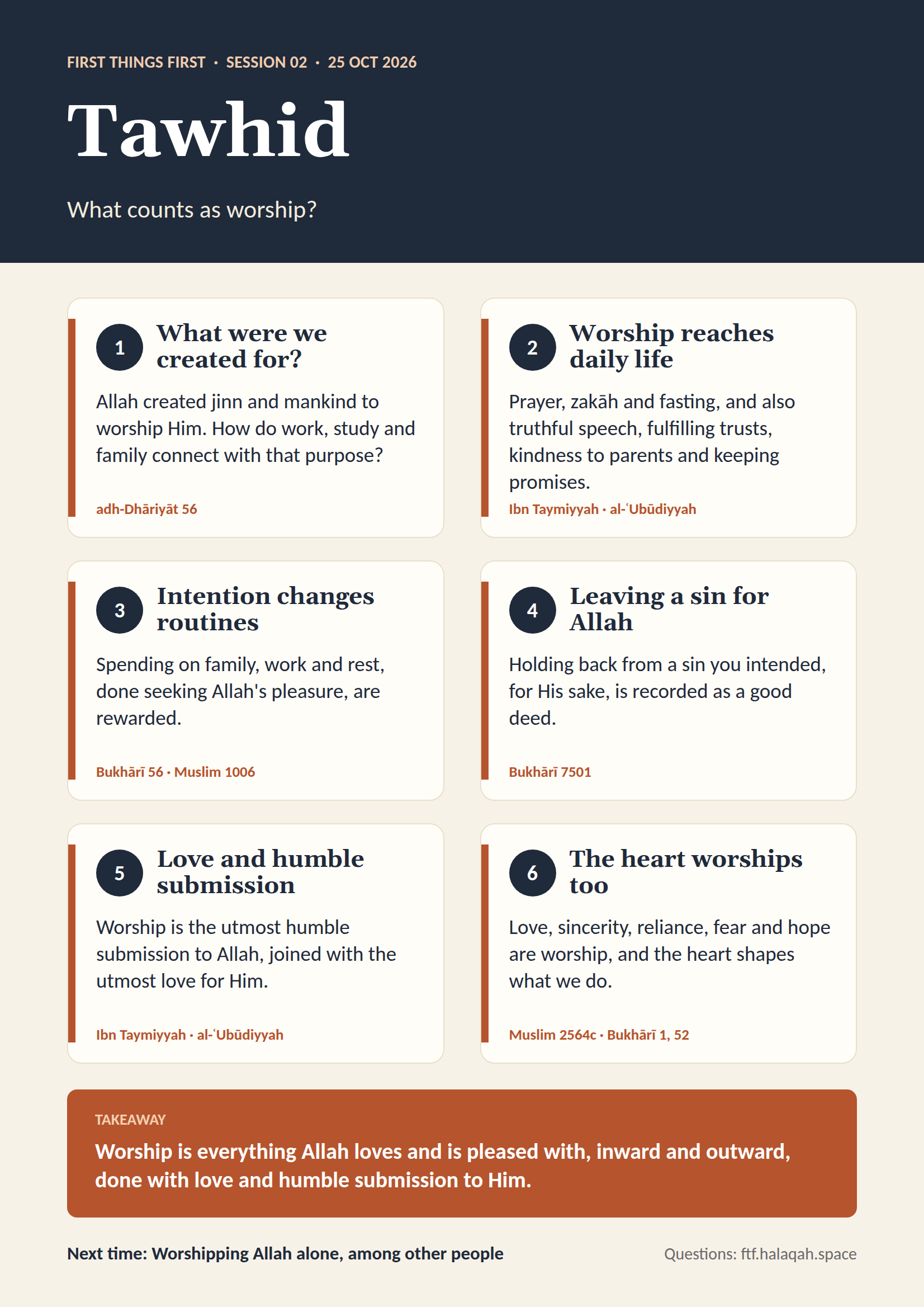
First Things First, Session 02, Sunday 25 Oct 2026. Written from the class recording and slides. Quran and hadith are referred to by source only: for the exact wording, see the slides or the source itself.
Why this lesson
- Last lesson: lā ilāha illallāh means no one deserves to be worshipped except Allah. Quraysh already accepted Allah as the Creator; what they resisted was worshipping Him alone.
- So what does that worship include? Allah created the jinn and mankind to worship Him (adh-Dhāriyāt 56). How do work, study, raising children and caring for others connect with that purpose?
What worship includes
- Ibn Taymiyyah (al-ʿUbūdiyyah) lists prayer, zakāh, fasting and ḥajj in the same discussion as truthful speech, fulfilling trusts, kindness to parents, family ties and keeping promises.
- Spending on our family while seeking the Face of Allah is rewarded, even what a husband puts into his wife's mouth (Ṣaḥīḥ al-Bukhārī 56).
- Lawful intimacy between husband and wife is rewarded, just as fulfilling the desire in a forbidden way is a sin (Ṣaḥīḥ Muslim 1006). al-Nawawī: permissible activities become acts of obedience through sincere intentions. Lawful work and rest can be worship too.
- Leaving a sin we intended, for Allah's sake, is recorded as a good deed (Ṣaḥīḥ al-Bukhārī 7501).
- Ibn Taymiyyah's definition: worship is a comprehensive term for everything Allah loves and is pleased with, from inward and outward words and actions. A good intention does not allow inventing new practices; it begins with following Allah's guidance.
How we worship Allah
- Worship is the utmost humble submission to Allah, joined with the utmost love for Him (Ibn Taymiyyah, al-ʿUbūdiyyah).
- Love alone, as for a child or a friend, is not worship. Submission alone, to someone we dislike who forces us, is not worship. We love Allah and humbly submit to Him.
Why the heart matters
- Love of Allah, sincerity, reliance, gratitude, patience, fear and hope are actions of the heart, the foundations of faith and religion (Ibn Taymiyyah, al-Tuḥfah al-ʿIrāqiyyah).
- Allah looks at our hearts and deeds, not our appearances and wealth (Ṣaḥīḥ Muslim 2564c). Two people can give the same RM50; each will have what he intended (Ṣaḥīḥ al-Bukhārī 1).
- When the heart is sound, the whole body is sound (Ṣaḥīḥ al-Bukhārī 52). Ibn Rajab explains that what is in the heart shapes what we do outwardly.
In class
- Last week's question: what if someone says the testimony without meaning it? The scholars list conditions for lā ilāha illallāh, seven or eight, and one is truthfulness. The hypocrites said it, yet they will be in the lowest depths of the Fire (al-Nisāʾ 145).
- Students answered in the chat: a family visit becomes worship when we intend to please Allah and keep family ties; every act of worship joins love and humble submission; we care for our hearts because they worship and shape our actions.
Takeaway
Worship is everything Allah loves and is pleased with, inward and outward, done with love and humble submission to Him. This week: bring an intention to one ordinary responsibility, and notice what your heart is doing in one act of worship.
Next time: We love our families, fear danger and ask people for help. What does worshipping Allah alone mean in the way we live with other people?
First Things First, Session 02, Sunday 25 Oct 2026. Written from the class recording and slides. Quran and hadith are referred to by source only: for the exact wording, see the slides or the source itself.
1. Last week's question
A student asked last week: what if someone said lā ilāha illallāh but did not want to, or said it while hating Islam? Would they enter Paradise?
The testimony is not only about pronouncing words. The words have a meaning, and we are meant to believe in it and accept it. The scholars discuss the conditions of lā ilāha illallāh; some mention seven, some eight, and one of them is truthfulness: we must mean what we say.
Think of the hypocrites at the time of the Prophet ﷺ. They said lā ilāha illallāh, yet Allah tells us they will be in the lowest depths of the Fire (Sūrah al-Nisāʾ, āyah 145). Their tongues said what their hearts did not believe, so it did not benefit them. From next week, questions will be answered during the week.
2. Where the last lesson left us
Last week we saw that acknowledging Allah as the Creator did not settle the disagreement with Quraysh: they believed Allah created, owns and controls everything. What they resisted was the call to worship Allah alone.
Asked in the chat what lā ilāha illallāh means, students answered: there is no deity worthy of worship except Allah. Not "there is no creator but Allah", but no one deserves worship except Him. Others are worshipped besides Allah, but not rightfully. Because Allah created us, owns us and provides for us, worship is His right alone. So what does that worship include?
3. What were we created for?
When asked to name acts of worship, students listed ṣalāh, duʿāʾ, fasting, hope and fear. This lesson shows how wide the meaning of worship (ʿibādah) is.
Allah tells us He did not create the jinn and mankind except to worship Him (Sūrah adh-Dhāriyāt, āyah 56). Understanding worship helps us understand our purpose in life. But much of our day is spent on ordinary responsibilities: work, study, raising children, looking after others. How do these connect with the purpose we were created for?
4. Worship in the same discussion
Ibn Taymiyyah, in his book al-ʿUbūdiyyah, explains the meaning of worship. He mentions the common acts: prayer, zakāh, fasting, ḥajj and dhikr. In the same discussion he mentions truthful speech, fulfilling trusts, kindness to parents, maintaining family ties and keeping promises.
Imagine someone trusts us with money. We could misuse it and they might never find out, but we return it. We might do this to be known as trustworthy, but a Muslim has a higher intention: Allah commands us to be trustworthy, and even if nobody else knows, Allah knows. When we fulfil trusts, honour our parents and keep family ties because Allah commands it, those actions become worship of Allah. We worship Allah through the way we fulfil the rights of His creation.
5. Spending on our family
The Prophet ﷺ taught that we never spend anything seeking the Face of Allah through it without being rewarded, even what a man puts into his wife's mouth (Ṣaḥīḥ al-Bukhārī 56, narrated by Saʿd ibn Abī Waqqāṣ).
Many of us already provide for our families without being told to: we buy food and pay the expenses. Here we are taught to consider our intention while we do it. The key words are "seeking the Face of Allah through it". Ibn Ḥajar, citing al-Nawawī, explains that such a moment can involve affection and enjoyment and still be rewarded: we can enjoy being kind to our family and seek Allah's pleasure through that same kindness.
6. The Companions' question
Some of the Companions came to the Prophet ﷺ saying the wealthy prayed and fasted as they did, but also had extra wealth to give in charity. He told them of other forms of charity, and among them was lawful intimacy between husband and wife. They asked whether one of them could satisfy his desire and be rewarded for it. He replied: if he fulfilled it in what is forbidden, would he bear sin? In the same way, when he fulfils it in what is lawful, he is rewarded (Ṣaḥīḥ Muslim 1006, narrated by Abū Dharr).
al-Nawawī, explaining this hadith, says it is evidence that permissible activities become acts of obedience through sincere intentions.
We can apply this to other routines:
- Lawful work: if we work to provide lawfully for those in our care, seeking Allah's pleasure, the time we spend working becomes worship.
- Rest and sleep: rest with the intention of regaining strength to continue worshipping Allah and fulfilling our responsibilities.
7. Leaving it for Allah
So far we have looked at things we do. What about something we choose to leave? The Prophet ﷺ reported that Allah said, concerning a servant who intended a sin: if he leaves it for My sake, record it for him as a good deed (Ṣaḥīḥ al-Bukhārī 7501, narrated by Abū Hurayrah). He did nothing; he left a sin he thought of doing.
Imagine someone who could lie for an advantage and get away with it, but remembers Allah and tells the truth even though it is bitter. Or someone about to look at something forbidden who looks away because he remembers Allah. Others may only see him put a phone down or change the subject, but Allah knows he left it for His sake.
The hadith does not say every sin we happen not to commit becomes a good deed. It is about having the opportunity to sin, or thinking of it, and deliberately leaving it for Allah. That restraint is among the greatest forms of worship.
8. What brings them together?
Gathering the examples: prayer, fasting, duʿāʾ and remembrance; obeying Allah in our dealings; lawful routines with a sound intention; and prohibited things we leave for Him. These overlap: providing for our family is both a dealing with people and an ordinary part of daily life.
Ibn Taymiyyah brings this together in his definition: worship is a comprehensive term for everything Allah loves and is pleased with, from inward and outward words and actions (al-ʿUbūdiyyah, Majmūʿ al-Fatāwā 10/149-150). So there are inward and outward words, and inward and outward actions.
We learn what Allah loves from what He has revealed. An ordinary activity such as resting stays a normal part of life; the intention is what makes it worship. This is different from inventing a new practice and claiming Allah loves it. A sound intention begins with following Allah's guidance.
Some worship can be heard or seen, like truthful speech or returning a trust. Other actions are hidden from everyone except ourselves and Allah: the actions of the heart.
9. Love and humble submission
What is the reality of worship? Ibn Taymiyyah explains it as the utmost humble submission to Allah, joined with the utmost love for Him (al-ʿUbūdiyyah, Majmūʿ al-Fatāwā 10/153). "Utmost" means the most there can be.
Consider the two separately:
- Love without submission: we love a child or a friend, enjoy being with them and want good for them, but we do not turn to them as servants to their Lord.
- Submission without love: someone may obey a person who has power over him, such as a boss at work, while disliking him in his heart.
Neither alone is the worship Allah deserves. We love Allah, so we want Him to be pleased with us, do what He loves and leave what angers Him. At the same time we humble ourselves before Him: He is our Lord and we are His servants, in need of Him while He does not need us at all. So we do what He commands and keep away from what He forbids. Both belong in every act of worship: love and humble submission.
10. Actions of the heart
In prayer our bodies stand, recite, bow and prostrate. But what is happening in our hearts? Ibn Taymiyyah (al-Tuḥfah al-ʿIrāqiyyah) calls the actions of the heart the foundations of faith and religion: love of Allah, sincerity, reliance, gratitude, patience, fear and hope. All are worship of the heart, seen by no one except ourselves and Allah.
People can see us giving money but not why we give it; they can see us standing in prayer but not our hope that Allah accepts it, our fear of His punishment for our sins, or our intention. Allah does not look at our appearances and wealth, but at our hearts and deeds (Ṣaḥīḥ Muslim 2564c, narrated by Abū Hurayrah). So when we provide for someone, we make sure we seek Allah's pleasure, and when we pray, we remember who we are praying to and why.
The same gift, different intentions. Two people each give RM50 in ṣadaqah to help a family. One thinks, "I hope Allah rewards me for this." The other thinks, "I want people to see this and say I'm generous." From the outside they look exactly the same, but to Allah the difference between them is like the difference between the sky and the earth. Each will have what he intended (Ṣaḥīḥ al-Bukhārī 1, narrated by ʿUmar ibn al-Khaṭṭāb).
11. How the heart affects our actions
The Prophet ﷺ said there is a piece of flesh in the body: when it is sound, the whole body is sound, and when it is corrupt, the whole body is corrupt; it is the heart (Ṣaḥīḥ al-Bukhārī 52, narrated by al-Nuʿmān ibn Bashīr). Ibn Rajab (Jāmiʿ al-ʿUlūm wa-l-Ḥikam, on the sixth hadith) explains that upright conduct and avoiding forbidden things are closely tied to the state of the heart: love of Allah and fear of what displeases Him show in the actions of the limbs.
- Holding back a hurtful word: we want to say something hurtful, then remember that Allah hears us and we will answer to Him, so we hold our tongue.
- Making the effort to do good: ʿumrah takes time, effort and savings, but we remember the reward Allah has prepared, especially in Ramaḍān, and go ahead because our heart hopes for it.
This is why a list of bodily actions cannot tell us everything about worship. We also need to learn about love, intention, fear and hope. Taking care of our hearts has a great effect on what we do, and the scholars from the earliest times have written many books on the actions of the heart.
12. Three main points
- What worship includes: everything Allah loves and is pleased with, reaching into daily life.
- How we worship Allah: with the utmost humble submission and the utmost love together.
- Why the heart matters: the heart worships Allah, and its state affects our actions.
Bring it into tomorrow. Choose one ordinary responsibility you already have, as small as folding clothes or as big as caring for a large family, and bring an intention to fulfil it in obedience to Allah. And in one act of worship you already perform, such as ṣalāh or giving, pay attention to what your heart is doing: are you remembering Allah, or just going through the motions? Allah's right reaches into the inward and outward parts of our lives.
13. Class discussion
Three questions were asked in the chat:
- Someone visits his family regularly. How can that be worship? Students answered: by intending to please Allah and to maintain the ties of kinship. An ordinary visit becomes worship when he keeps family ties in obedience to Allah and seeks His pleasure.
- When we pray, what two things should come together in our worship? Answers included intention and sincerity, humility, and fear and hope. The answer looked for: utmost love and humble submission, present in every act of worship, not only prayer but also zakāh, fasting and ḥajj.
- Why care for our hearts as well as our outward actions? Students answered: the state of the heart affects our outward actions; if the heart is sound our actions will be correct; worship can be from the heart; actions are by intentions. In summary: love, sincerity, reliance, fear and hope are themselves worship, Allah knows what is in our hearts, and the state of the heart affects what we do.
Takeaway
Worship is everything Allah loves and is pleased with, inward and outward, in our dealings, our routines and the sins we leave for Him. We worship Him with love and humble submission together, and it begins in the heart.
Next time: Worship includes love, hope and fear, yet we love our families, fear danger and ask people for help. What does worshipping Allah alone mean in the way we live with other people?
References used in this lesson
Sūrah al-Nisāʾ 145; Sūrah adh-Dhāriyāt 56; Ṣaḥīḥ al-Bukhārī 1, 52, 56, 7501; Ṣaḥīḥ Muslim 1006, 2564c; Ibn Taymiyyah, al-ʿUbūdiyyah (Majmūʿ al-Fatāwā 10/149-150, 10/153) and al-Tuḥfah al-ʿIrāqiyyah; Ibn Ḥajar, citing al-Nawawī (on Ṣaḥīḥ al-Bukhārī 56); al-Nawawī, Sharḥ Ṣaḥīḥ Muslim (on 1006); Ibn Rajab, Jāmiʿ al-ʿUlūm wa-l-Ḥikam (sixth hadith).
Questions and Answers
Have a question about this lesson? Ask it during the week. Ustadz Fawwaz answers, and answered questions appear below.
Want to track your progress and keep your questions in one place? Join the Classroom.