
Lesson Materials
Watch the lesson, review the slides, or read the summaries.
Watch The Recording
Tap to play the recordingView Slides
Summaries
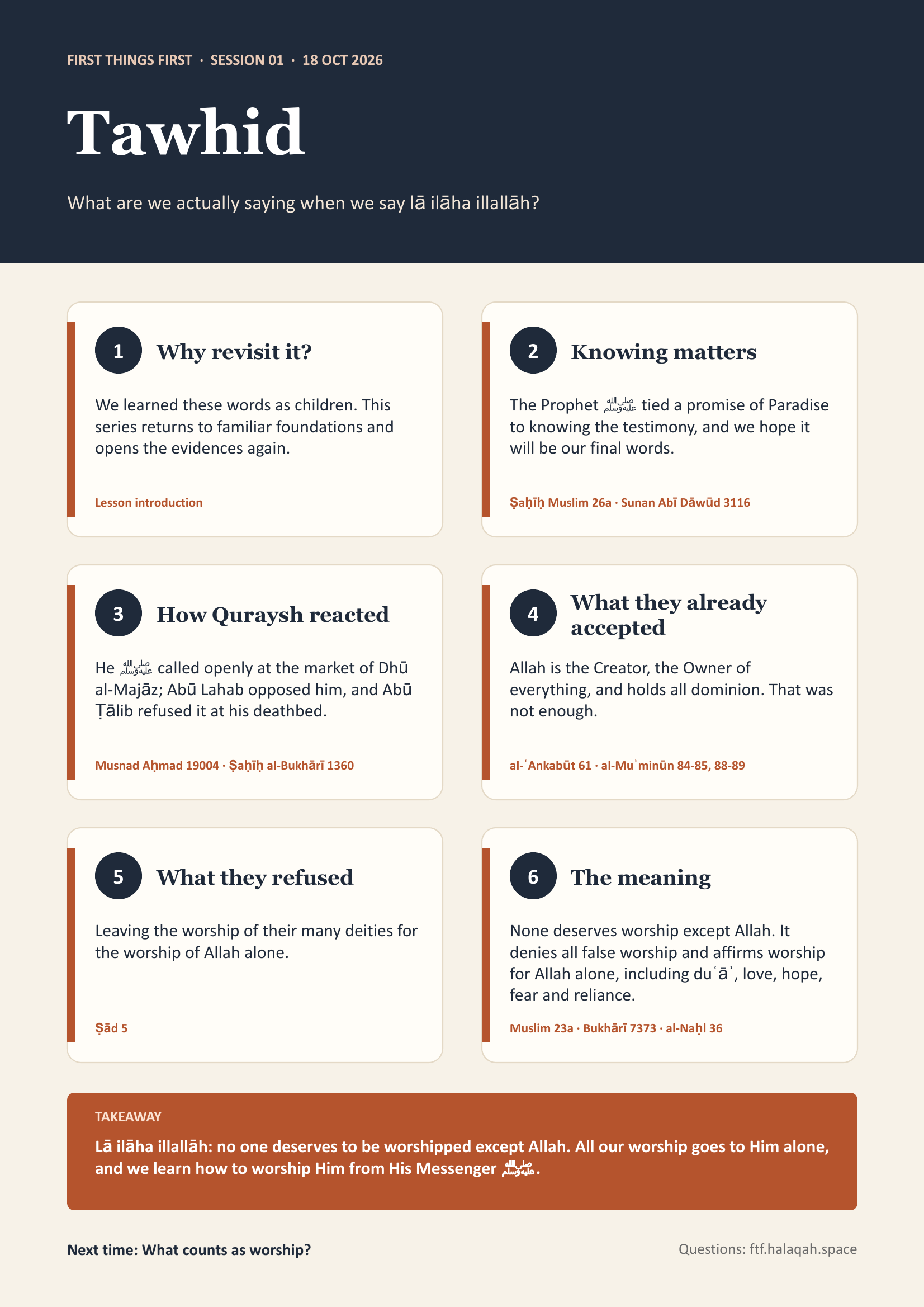
1. A Familiar Statement, but a Serious Invitation
The Prophet ﷺ called people to say:
يَا أَيُّهَا النَّاسُ، قُولُوا لَا إِلَهَ إِلَّا اللَّهُ تُفْلِحُوا
“O people, say lā ilāha illallāh, and you will succeed.”
At the market of Dhū al-Majāz, he invited people to these words, while Abū Lahab followed him, warning people against accepting his message.
Why would such a short statement provoke such strong opposition?
2. Why Did Abū Ṭālib Refuse?
Even as his uncle Abū Ṭālib was dying, the Prophet ﷺ urged him to say lā ilāha illallāh.
But others present urged Abū Ṭālib to remain upon the religion of his forefathers. He ultimately did not accept the testimony.
This incident helps us recognize something important: these words were not understood as something a person could say while continuing to worship as before.
They demanded a change in whom a person worshipped.
3. What Did Quraysh Already Believe?
The Qur'an tells us that if Quraysh were asked who created the heavens and the earth, they would answer: Allah (Al-ʿAnkabūt 29:61).
They also acknowledged that all dominion was in Allah's hand, and that He grants protection while none can protect against Him (Al-Muʾminūn 23:88–89).
So their disagreement with the Prophet ﷺ was not simply about whether Allah existed or whether He was the Creator.
They already acknowledged these things, yet they were still upon shirk.
Why?
4. What Were They Refusing?
Allah records their objection:
أَجَعَلَ الْآلِهَةَ إِلَٰهًا وَاحِدًا ۖ إِنَّ هَٰذَا لَشَيْءٌ عُجَابٌ
“Has he made the gods into one God? Indeed, this is something astonishing.” (Ṣād 38:5)
Quraysh understood that the Prophet ﷺ was calling them to abandon the worship of other gods and worship Allah alone.
They acknowledged Allah's greatness, but refused to single Him out in worship.
This was the heart of their disagreement.
5. What Does Lā Ilāha Illallāh Actually Mean?
We commonly translate it as “There is no god but Allah.”
But the scholars explain its fuller meaning as:
لَا مَعْبُودَ بِحَقٍّ إِلَّا اللَّهُ
None deserves to be worshipped except Allah.
The words do not deny that other things are worshipped. People have worshipped idols, people, and many other things.
The distinction is between what is worshipped and what deserves to be worshipped.
Only Allah deserves that worship.
6. Two Parts of One Testimony
The testimony contains both denial and affirmation.
لَا إِلَهَ — Lā ilāha: Nothing besides Allah deserves worship.
إِلَّا اللَّهُ — Illallāh: Allah alone deserves worship.
Both parts belong together. It is not enough to acknowledge Allah while directing worship to others.
7. What Does This Mean for Us?
The Prophet ﷺ explained to Muʿādh ibn Jabal that Allah's right over His servants is that they worship Him and associate nothing with Him (Al-Bukhārī and Muslim).
This is why understanding lā ilāha illallāh matters.
We don't only want to know how to pronounce these words. We want to understand what they require of us.
Allah alone deserves our worship. The next question is: what actually counts as worship?
1. About the series
First Things First meets every Sunday at 5:15 pm Malaysia time, with two lessons each week of about 45 minutes each: one on Tawhid and one on Wuḍūʾ. During class, questions go into the Q&A tool in Google Meet, and the most upvoted question is answered first.
Why the name? Most of us learned lā ilāha illallāh when we were little. We learned wuḍūʾ by watching our parents or someone at the masjid, and we grew up hearing the adhān. These things stayed with us, but once we have known something for years we rarely revisit it. We can say a sentence perfectly without having thought much about everything it means, or perform wuḍūʾ every day without being sure of the evidence for one of its steps. The series returns to these familiar foundations and opens the evidences again. Sometimes we will find something we missed, sometimes a new meaning in a familiar sentence, and sometimes we will simply understand more clearly why we have been doing something correctly all along.
2. Why knowing the meaning matters
The lesson opened with a question: what are we actually saying when we say lā ilāha illallāh? The words come to us very easily, in the adhān, in our dhikr after ṣalāh and in the morning and evening.
In a hadith in Ṣaḥīḥ Muslim (26a, narrated by ʿUthmān ibn ʿAffān), the promise of Paradise is connected to the person knowing the testimony. The Prophet ﷺ specifically mentioned knowing. Many of us learned to pronounce it years ago, but could we explain what it means to our child, or to a new Muslim who asked us?
A second hadith (Sunan Abī Dāwūd 3116, narrated by Muʿādh ibn Jabal, authenticated by al-Albānī) connects Paradise with these being a person's final words. That is one reason the Sunnah teaches us to remind someone on their deathbed to say it. The words many of us learned as children are the words we hope to carry out of this world, which is why it is so important to understand them while we still can.
3. How the people of the Prophet ﷺ received the call
The market of Dhū al-Majāz. The Companion Rabīʿah ibn ʿAbbād described seeing the Prophet ﷺ in this market, where people gathered, calling them openly to say lā ilāha illallāh and promising them success (Musnad Aḥmad 19004). A man followed him through the market contradicting him, calling him a ṣābiʾ (Quraysh's hostile label for someone who has left the religion of his people) and a liar. Rabīʿah asked who he was and was told it was Abū Lahab, the Prophet's ﷺ own uncle.
A question to think about: what did Abū Lahab understand about this statement that made him oppose it so openly? For many of us it is simply part of being Muslim, but for them accepting it meant going against the religion they grew up with, and facing opposition even from family.
Abū Ṭālib's deathbed. Another uncle, Abū Ṭālib, had protected the Prophet ﷺ for years. At the end of his life the Prophet ﷺ visited him and asked him to say lā ilāha illallāh, words by which he could testify for him before Allah. Two leaders of Quraysh were present, Abū Jahl and ʿAbdullāh ibn Abī Umayyah, and they kept asking him whether he would turn away from the religion of ʿAbd al-Muṭṭalib. Each side kept repeating its appeal until Abū Ṭālib's last statement was that he remained on the religion of ʿAbd al-Muṭṭalib, and he refused to say it (Ṣaḥīḥ al-Bukhārī 1360, narrated by al-Musayyab ibn Ḥazn). This is one of the hardest parts of the narration: the uncle who supported him did not follow him into Islam.
4. What Quraysh already acknowledged
Was the Prophet ﷺ asking them to accept, for the first time, that Allah created the heavens and the earth? The Quran shows that they already accepted this:
- Creator: Sūrah al-ʿAnkabūt, āyah 61. al-Baghawī (Maʿālim al-Tanzīl) explains that the people meant are the disbelievers of Makkah, the same Quraysh from the two scenes above.
- Owner: Sūrah al-Muʾminūn, āyāt 84-85. Creation happened long ago, but ownership reaches into the present: everything belongs to Allah, and they accepted this.
- Dominion and protection: Sūrah al-Muʾminūn, āyāt 88-89. Who has power over everything, and who can protect against Him? Once again, only Allah.
So what were they still refusing?
5. What they refused
We do not have to guess: the Quran records their objection in their own words in Sūrah Ṣād, āyah 5. Their complaint was that he made their many deities (al-ālihah, the ones they directed worship to) into one God. When the Prophet ﷺ called them to lā ilāha illallāh they understood immediately that it meant directing worship to Allah alone and leaving their other objects of worship.
So even though they believed Allah created, owns and controls everything, it was not enough, because they still directed worship to others. Accepting the testimony meant changing what was at the very centre of their religion: whom they worshipped. This explains both Abū Lahab's accusation and the pressure on Abū Ṭālib.
For our own lives: if everything we have comes from Allah, then when we pray and make duʿāʾ, the One who deserves that worship is the One who created us and provides for us.
6. The meaning of lā ilāha illallāh
The scholars explain it as: no one deserves to be worshipped except Allah (lā maʿbūda bi-ḥaqqin illallāh). It has two parts:
- Denial (lā ilāha): no one and nothing besides Allah deserves our worship, whether a tree, an idol, a stone, a jinn, an angel or anything else.
- Affirmation (illallāh): Allah alone deserves all of our worship: our prayers, sujūd, duʿāʾ, sacrifices and every other act of worship.
The word bi-ḥaqq, "rightfully", matters. People have worshipped idols, the sun and the moon, angels and righteous people. The testimony does not say nothing else is worshipped; it says nothing else deserves worship. Being worshipped does not make anything deserving of it.
Rejecting false worship. A hadith in Ṣaḥīḥ Muslim (23a, narrated by Ṭāriq ibn Ashyam) links the protection of a person's life and property to saying lā ilāha illallāh and rejecting what is worshipped besides Allah. It is not enough only to worship Allah; we must also reject everything worshipped besides Him.
Allah's right over His servants. In a hadith in Ṣaḥīḥ al-Bukhārī (7373), the Prophet ﷺ, riding with Muʿādh ibn Jabal, asked him what Allah's right over His servants is, and taught that it is to worship Him alone without associating anything with Him. This connects with "rightfully" above: worship is Allah's right, so none of it, small or large, may be directed to a prophet, an angel, or anything lower. He deserves it because He created us, provides for us, owns everything and has complete power over us.
7. Worship is more than ṣalāh
When we pray, we worship Allah. When we make duʿāʾ, asking for forgiveness, guidance, provision or help in difficulty, that is also worship, and among the greatest kinds. There is also the worship of the heart: loving Allah above everything, hoping for His mercy, fearing His punishment and trusting Him. All of these belong to Allah alone. What exactly counts as worship, and what does not, will be studied in the coming lessons.
8. The call of every messenger, and the second testimony
The message is much older than Makkah. Allah sent a messenger to every nation with the same call: worship Allah and avoid ṭāghūt, the false objects of worship set up in rivalry with Him (Sūrah al-Naḥl, āyah 36). From Nūḥ to the call in the market of Dhū al-Majāz, it is the same essential call with its two halves of denial and affirmation.
The second testimony, that Muḥammad ﷺ is the Messenger of Allah, completes the picture: we do not have to work out for ourselves how to worship Allah. How we pray, make wuḍūʾ, pay zakāh, and treat our parents and neighbours, we learn from the Messenger He sent.
9. Class discussion
A question asked in the chat: Quraysh acknowledged that Allah created, owned and controlled everything, so what was still missing? Several answers said "Allah is the only God" or "one creator", but that needs more precision: being the only Creator is what Quraysh already accepted. The answer, given by students in the chat, was that Allah is the only one who deserves to be worshipped.
A question sent during class will be answered at the beginning of the next Tawhid lesson.
Takeaway
Lā ilāha illallāh means that none deserves to be worshipped except Allah. All our worship goes to Him alone, we reject everything worshipped besides Him, and we learn how to worship Him from His Messenger ﷺ.
Next time: What counts as worship? Prayer and duʿāʾ, and what about hope, fear, love and reliance?
References used in this lesson
Ṣaḥīḥ Muslim 26a, 23a; Sunan Abī Dāwūd 3116; Musnad Aḥmad 19004; Ṣaḥīḥ al-Bukhārī 1360, 7373; Sūrah al-ʿAnkabūt 61; Sūrah al-Muʾminūn 84-85, 88-89; Sūrah Ṣād 5; Sūrah al-Naḥl 36; al-Baghawī, Maʿālim al-Tanzīl (on al-ʿAnkabūt 61).
Questions and Answers
Have a question about this lesson? Ask it during the week. Ustadz Fawwaz answers, and answered questions appear below.
Want to track your progress and keep your questions in one place? Join the Classroom.